· by Katie Matski · 5 min read
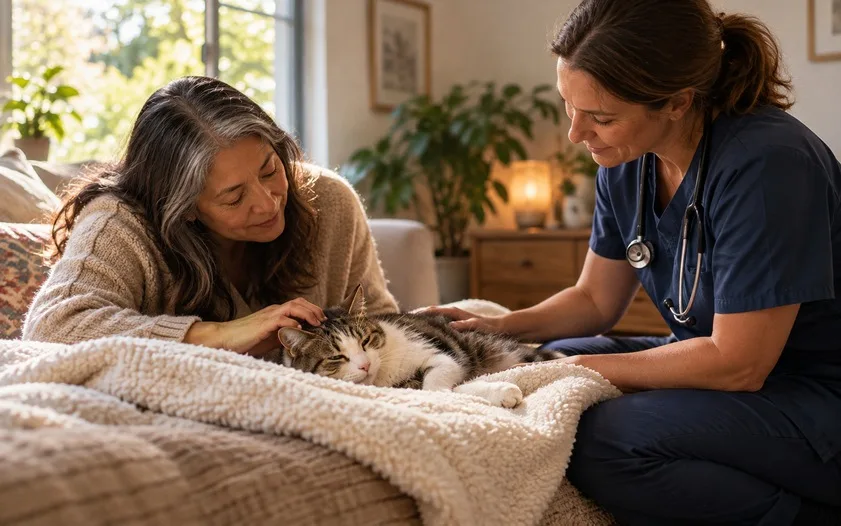
If your cat is declining and the thought of a carrier, a car ride, and a cold exam room feels like too much, in-home euthanasia lets you say goodbye where she already feels safe. A veterinarian comes to you, your cat rests in her favorite spot, and you can take all the time you need. When you are ready, or even if you are only starting to wonder, you can reach out to our team at (775) 800-6463. There is no pressure in that first conversation.
How do you know when it's time to say goodbye to your cat?
There is rarely one clear moment. Most families notice a slow gathering of small changes, and it helps to know that cats are experts at hiding pain.
In the wild, a cat that looks weak becomes a target, so even a beloved indoor cat will keep her discomfort quiet for as long as she can. That means the signs tend to be subtle. She may stop grooming, so her coat looks greasy or matted along the back. She might skip the jump to the windowsill she used to reach without thinking, or sit hunched with her paws tucked tightly underneath her. Some cats stop using the litter box, eat a few bites and walk away, or start sleeping in closets and under beds where they never slept before.
Whether you live in an older house in the Old Southwest or a newer place out in Sparks, those quiet changes look the same, and they are worth taking seriously. A quality of life scale can help you sort through what you are seeing. So can a calm phone call with a veterinarian who has walked many families through this same question. You do not have to decide alone.
Why is in-home euthanasia calmer for cats than a clinic visit?
Because most cats find the carrier, the car, and the clinic frightening, and a final visit should not be one of their most stressful hours. At home, she stays in her own space with her own smells and her own people.
Many Reno cats have a favorite patch of sun, a window looking out toward Mount Rose or a warm spot on the bed in the afternoon. Letting her rest there keeps her calm, and it lets you stay close without an exam table between you. Other pets can be present to understand what happened, which some families find helps them grieve too.
We think often about one Reno cat whose story stays with us. She would hide every time her owner brought out the carrier for a vet visit. Near the end she was having trouble with the stairs, and sometimes she would simply stay at the bottom and look up. Instead of fighting to get her into the carrier one last time, her family let her take her final rest on the bed she loved so much. What they remember now is a peaceful afternoon. If that kind of goodbye feels right for your cat, our in-home pet euthanasia visits are built around it.
What happens during an in-home euthanasia visit?
The veterinarian gives a gentle sedative first, so your cat relaxes fully into a deep sleep before anything else happens. Only then is the final medication given.
We start by talking with you, answering questions, and letting you settle in. Nothing is rushed. During the sedation, you can hold her, stroke her head, or simply sit beside her and talk to her. Many families tell us that watching their cat finally relax, after weeks of seeing her uncomfortable, is a relief in itself. Once she is sound asleep, the veterinarian gives the final injection and then listens to her heart to confirm she has passed peacefully.
Our doctors visit homes seven days a week, often within 12 to 24 hours of your call. Families in Reno, Sparks, and Washoe Valley have no travel fee, and we travel farther into Northern Nevada for a flat fee. If you want to understand every step of our pet euthanasia care before you call, we are happy to go through it with you.
What aftercare and cremation choices do Reno families have?
You can choose communal, individual, or private cremation, and we take your cat with us so you do not have to arrange transport yourself. A clay pawprint keepsake is included with every visit.
With communal cremation, your cat is cremated alongside other pets and the ashes are not returned. Instead, they are scattered at sea. With individual cremation, she is cremated separately from other pets using a partition, and her ashes come back to you in an urn or a satin keepsake pouch. Private cremation means she is the only pet in the chamber, and only her ashes are returned. Some families already know which they want. Others decide in the moment, and that is completely fine. The pawprint, pressed gently while she rests, is often the thing people tell us they hold onto most.
Whenever you are ready to talk, we are here. Call Rover Veterinary Care at (775) 800-6463 or send us a message, and we will help you plan a gentle goodbye at home, at your cat's pace and yours.